Teaching AI Genomics with a DNA Mirror: How Self-GenomeNet Cracks the Data-Scarcity Problem
Teaching AI Genomics with a DNA Mirror: How Self-GenomeNet Cracks the Data-Scarcity Problem
Deep learning has shaken up genomics, but it eats labeled data for breakfast, and labels are expensive. What if we could tap into the petabytes of unlabeled sequences already sitting in public databases? New work introduces a biology-aware self-supervised method that gets surprisingly far on a fraction of the usual labels.
Key Findings
- Data Efficiency Champion: Self-GenomeNet matches standard supervised models while using ~10 times fewer labeled examples. That matters a lot for tasks where annotation is slow or costly.
- Biology-Inspired Learning: By training AI to predict the reverse-complement of DNA sequences of varying lengths, the model picks up transferable patterns that generic self-supervised methods miss.
- Generalizable Knowledge: The representations aren't locked to one task. They transfer to new datasets and different genomic prediction problems, suggesting the model has actually learned something about the "language" of DNA rather than memorising a benchmark.
Why It Matters
For bioinformaticians, this hits a real bottleneck. Annotating genomic regions for function, regulation, or disease association is labor-intensive. Self-GenomeNet offers a pre-training strategy that can bootstrap models for downstream tasks, from variant effect prediction to identifying functional elements, which makes modern deep learning more usable for labs with limited labeled data.
Technical Approach
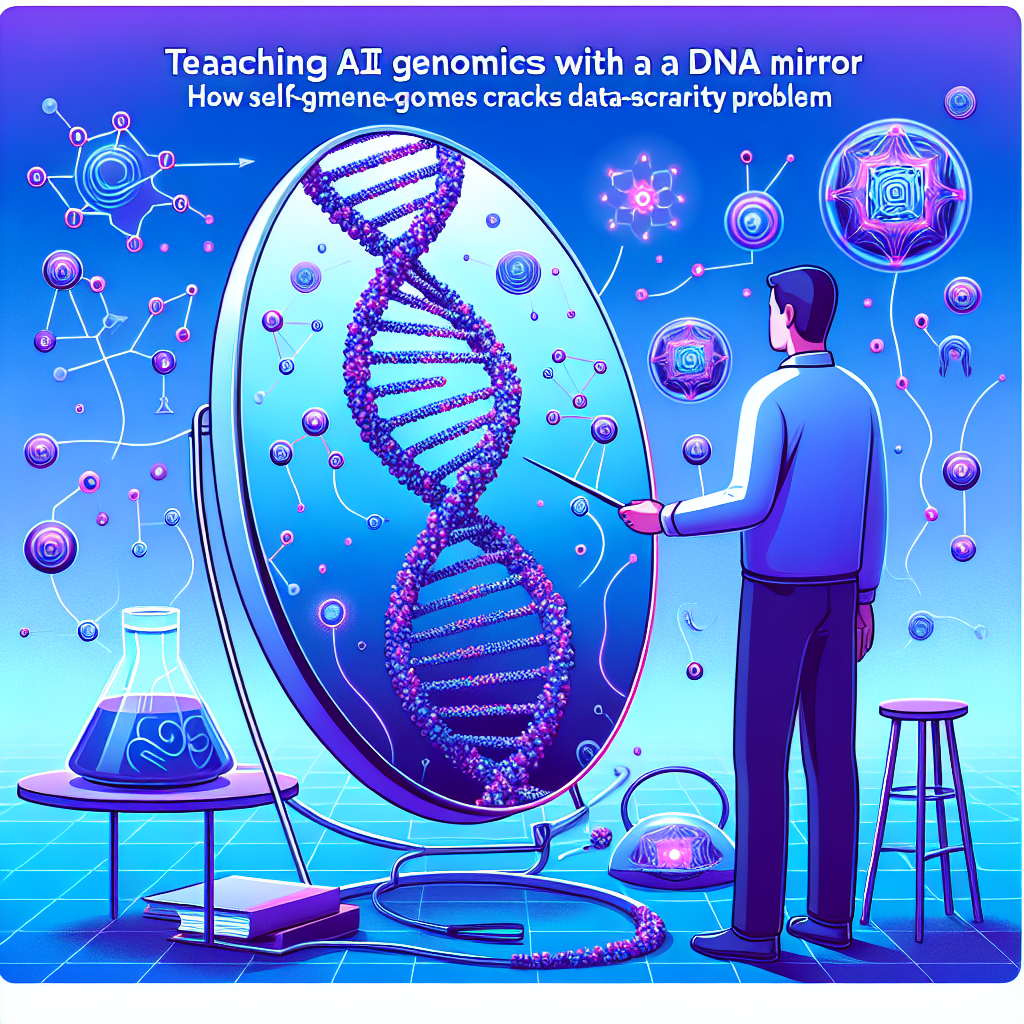
The core idea is simple, and that's the appeal. DNA has a built-in symmetry: its reverse-complement (reverse the sequence, then pair A↔T and C↔G). Self-GenomeNet is trained in a self-supervised way on large amounts of unlabeled DNA. It takes a sequence snippet and tries to predict its reverse-complement, at both short and long spans. That forces it to learn local patterns, like transcription factor binding motifs, as well as longer-range structure, without a single human-provided label. The pre-trained model is then fine-tuned with a small amount of labeled data for a specific task, where it performs well.
Read More
Explore the original research paper published in Communications Biology:
A self-supervised deep learning method for data-efficient training in genomics by Gündüz et al. (2023).