Paper Outlook — September 28 - October 4, 2026

TL;DR
- Spatial and single-cell tools keep reshaping how we see tumors and tissues, from rare cell states in male breast cancer to immune neighborhoods around hair follicles in pattern baldness.
- The tumor microenvironment isn't scenery: fibroblasts carrying GLG1 can fuel bladder cancer growth, which is a good reminder that non-cancer cells are active players.
- Older landmark work on TNBC subtypes and high-resolution spatial bead arrays still anchors today's spatial biology wave, and cfDNA sequencing is pushing liquid biopsy closer to clinical-grade sensitivity.
Disturbance of Immune Microenvironment in Androgenetic Alopecia through Spatial Transcriptomics
This study uses spatial transcriptomics — a technique that maps gene activity while preserving tissue location — to look at immune cells clustered around hair follicles in people with pattern baldness. The authors zoom in on the upper follicle region, where inflammation appears to track with hair loss. It's a useful new angle for therapies aimed at the immune side of baldness, rather than just hormones.
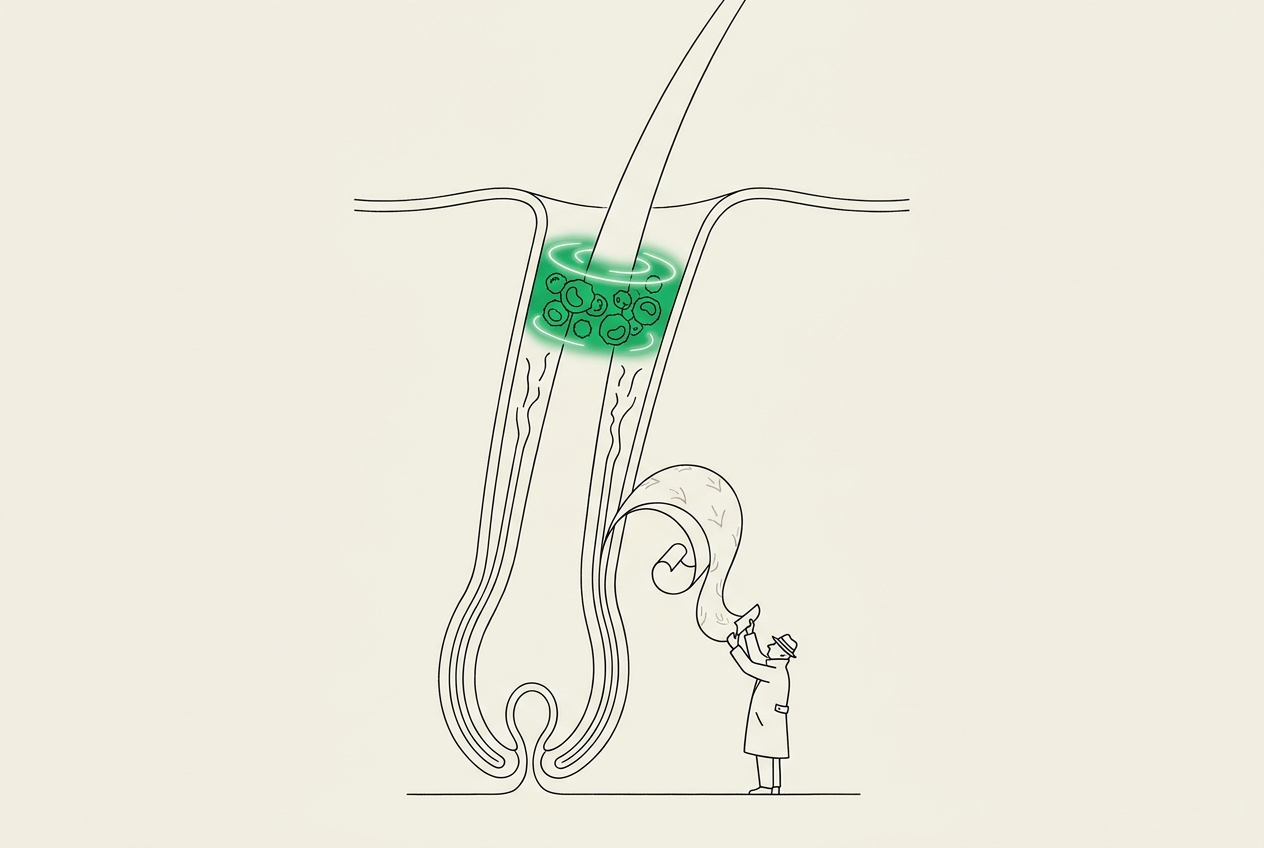
International Journal of Molecular Sciences (2024) · 22 citations
Read the original → https://doi.org/10.3390/ijms25169031
Multiplatform single-cell and spatial transcriptomics reveal sex-specific malignant states and architecture in male breast cancer.
By layering several single-cell and spatial technologies across more than 660,000 cells, the authors built a detailed atlas of male breast cancer. They flag a male-specific tumor cell type linked to worse outcomes and show how these cells sit near fat metabolism signals in tissue. The atlas points to sex-specific biology that current, largely female-derived treatment guidelines may miss.

Science advances (2026)
Read the original → https://doi.org/10.1126/sciadv.aeg7722
GLG1 in cancer-associated fibroblasts promotes bladder cancer growth while limiting tumor apoptosis.
The team combined single-cell RNA sequencing of bladder tumors with genetic analyses to single out GLG1, a gene active in cancer-supporting fibroblasts. Functional experiments suggest GLG1 helps tumors grow while limiting cancer cell death, partly through TGF-β signaling. That makes GLG1 a candidate worth watching as a drug target in bladder cancer.

Apoptosis : an international journal on programmed cell death (2026)
Read the original → https://doi.org/10.1007/s10495-026-02439-3
High-definition spatial transcriptomics for in situ tissue profiling
This methods paper introduced a high-definition spatial transcriptomics platform that captures RNA on densely packed barcoded beads at 2-micrometer resolution. The team demonstrated the approach in mouse brain and human breast cancer tissue. It helped open the door to the high-resolution spatial biology now common in research labs.

Nature Methods (2019) · 1007 citations
Read the original → https://doi.org/10.1038/s41592-019-0548-y
Genomic and Transcriptomic Landscape of Triple-Negative Breast Cancers: Subtypes and Treatment Strategies.
The authors profiled 465 triple-negative breast cancers — an aggressive subtype that lacks the usual drug targets — using genomic and transcriptomic data, including a large Chinese cohort. They grouped tumors into four molecular subtypes with distinct vulnerabilities and proposed different treatment strategies for each. The paper is still a go-to reference for TNBC classification and clinical trial design.

Cancer Cell (2019) · 893 citations
Read the original → https://doi.org/10.1016/j.ccell.2019.02.001
High-intensity sequencing reveals the sources of plasma circulating cell-free DNA variants
This study tested a deep-sequencing blood test that reads DNA fragments shed by tumors into the bloodstream, covering over 500 genes at very high depth. By comparing blood, tumor, and white blood cell samples from metastatic cancer patients and healthy controls, the team worked out which mutations truly came from tumors versus normal blood cells. The findings push liquid biopsy toward more reliable cancer detection and monitoring.

Nature Medicine (2019) · 677 citations
Read the original → https://doi.org/10.1038/s41591-019-0652-7
Quick links
| Paper | Venue / Year | Link |
|---|---|---|
| Disturbance of Immune Microenvironment in Androgenetic Alopecia through Spatial Transcriptomics | International Journal of Molecular Sciences (2024) | Read → |
| Multiplatform single-cell and spatial transcriptomics reveal sex-specific malignant states and architecture in male breast cancer. | Science advances (2026) | Read → |
| GLG1 in cancer-associated fibroblasts promotes bladder cancer growth while limiting tumor apoptosis. | Apoptosis : an international journal on programmed cell death (2026) | Read → |
| High-definition spatial transcriptomics for in situ tissue profiling | Nature Methods (2019) | Read → |
| Genomic and Transcriptomic Landscape of Triple-Negative Breast Cancers: Subtypes and Treatment Strategies. | Cancer Cell (2019) | Read → |
| High-intensity sequencing reveals the sources of plasma circulating cell-free DNA variants | Nature Medicine (2019) | Read → |